Why Your Ground Station Misses Most of Your Orbit
A satellite in low Earth orbit passes overhead sixteen times a day and talks to you far less than that. The gap between those two numbers decides most of what a small mission can and cannot do.
The pass budget of one antenna
A spacecraft at 500 to 800 kilometers completes an orbit every 90 to 100 minutes, so it makes 14 to 16 passes per day somewhere over the planet. Over any particular antenna the picture is much thinner: a single mid-latitude station sees a polar or sun-synchronous satellite only three to six times daily, and each of those contacts runs 5 to 15 minutes above a 5-degree elevation mask.
That is somewhere between 15 and 90 minutes of link per day, spread across contacts that arrive in two clusters separated by long silences. Everything else, roughly two thirds of the orbits flown, happens out of view.
Once a single site is clearly not enough, the next question is which network fills the gap, and a nine-network comparison by Sebastian Holt lines up the ground station services on coverage, band support, and how antenna time is sold, which is the practical frame for reading the GSaaS market.
What the elevation mask takes
Elevation masks look like a detail in a link budget and behave like a schedule constraint instead. Raising the mask from 5 to 10 degrees, whether for terrain, local interference, or antenna limits, cuts daily usable pass time substantially, with published estimates ranging from around a third to about half depending on orbit altitude.
The passes do not disappear evenly either. Low-elevation passes are the first to fall below the threshold, and those are the ones that fill the gaps between the good overhead passes. A 10-degree mask therefore costs proportionally more contacts than it costs minutes, and the schedule gets lumpier rather than merely shorter.
Why latitude decides more than hardware
For sun-synchronous missions the dominant variable is not antenna size or receiver quality; it is simply where the antenna sits.
| Station latitude | SSO passes per day | Practical consequence |
|---|---|---|
| Equatorial | At most 3–4 | Long blackouts, unsuitable as a sole site |
| Mid-latitude | 3–6 | Two clusters per day, most of the orbit unheard |
| Polar, above ~70° | Every orbit | A contact opportunity on essentially every pass |
Two commercial stations see every sun-synchronous pass: Svalbard at 78 degrees north and Troll at 72 degrees south. That geometry produces a daily-pass advantage of roughly three to four times over an equatorial facility, and no amount of ground hardware closes it at lower latitudes.
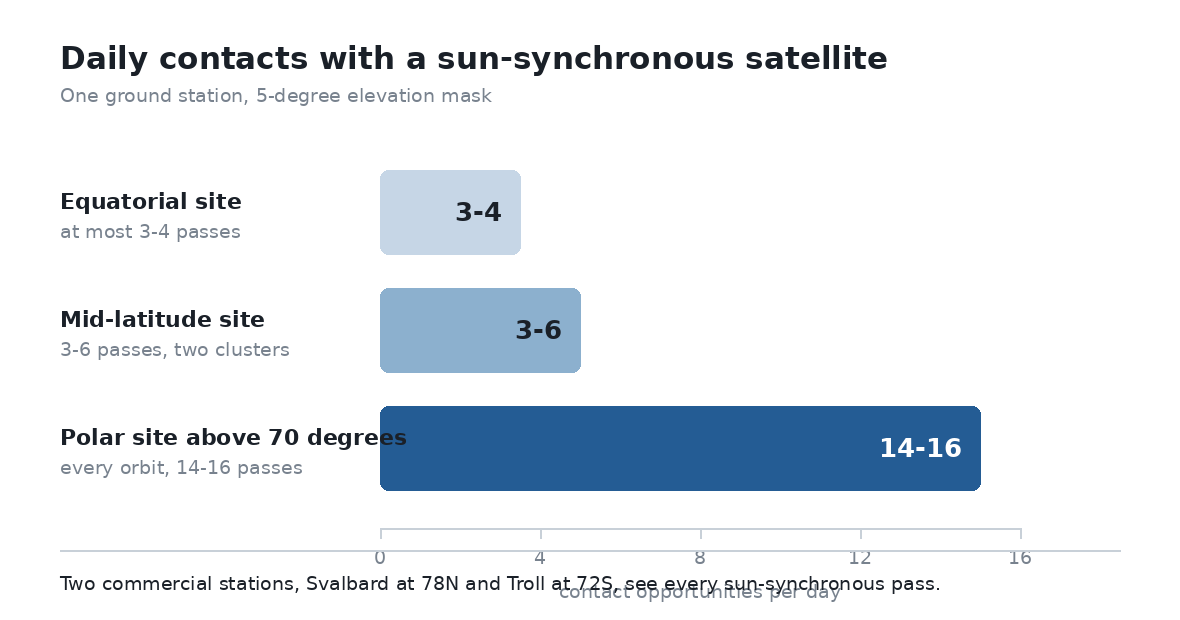
Daily contact opportunities with a sun-synchronous satellite, by station latitude. Source: own diagram, based on published contact-window geometry for LEO missions.
For a university mission with one antenna on campus, that table sets the ceiling. Adding a second dish at the same site changes nothing about it, because the constraint is geometric rather than technical.
When renting stops being the cheaper option
The claim that a service is always cheaper than owning does not survive contact with a spreadsheet. It holds at low and moderate volumes, which is where most small missions live, and it inverts above roughly 3,000 to 5,000 wideband contact-minutes per month per region, or around 15 daily passes per satellite.
Those thresholds are worth stating plainly because they sit far above a typical CubeSat workload. A single spacecraft with a narrowband beacon and a few megabytes per pass will not approach them for years, if ever. A constellation pushing X-band payload data every orbit crosses them quickly, which is why operators with ten or more satellites tend to end up with a hybrid: owned antennas at the sites they use hardest, plus rented capacity for gap-fill and surge.
The volume figure also explains why the two models rarely compete directly. They serve different points on the same curve, and the crossing point is calculable in advance rather than a matter of judgment.
What a service contract does not remove
One assumption is worth correcting before any procurement decision, because it survives well into contract drafts. Buying antenna time does not transfer the obligations an operator carries to the provider.
- The provider licenses its own sites, and the satellite operator still needs per-country radio licences of its own, under FCC Part 25 in the United States and equivalent regimes elsewhere.
- Shared bands require ITU coordination that stays with the operator regardless of whose antenna receives the signal.
- Export control applies to the data and sometimes to the hardware, and a foreign ground site can complicate rather than simplify that question.
- Contention for antenna time at popular local solar times is a real scheduling constraint, and work on contact scheduling shows it can leave data sitting onboard longer than planned.
None of these argues against using a service. They argue for keeping the licensing workstream running in parallel, rather than assuming a contract absorbed it.
The calculation worth doing first
Start from the orbit rather than the vendor list. Compute the number of passes a candidate site actually sees at the intended elevation mask, multiply by realistic pass duration, and compare the result against the data volume the payload generates per orbit. If the answer is that onboard storage fills faster than the link drains it, no choice of provider fixes the mission, and the design needs revisiting first.
Teams running spacecraft in the TechEdSat series tradition, with a beacon and volunteer receivers, sit at the far low end of this curve, where a modest station and a cooperative amateur network genuinely suffice. The point at which that stops being true arrives with the payload, not with the spacecraft count, and it arrives sooner than expected once imaging is involved.
Satellite mission design demands a kind of systems thinking that goes beyond sequential logic — recognising patterns across incomplete data, sensing thresholds before they become failures, and making confident decisions under genuine uncertainty. An essay from i.gy on how intuition works as a parallel processing tool offers a surprisingly relevant framework for anyone whose work depends on reading complex, fast-moving systems accurately.